
Introduction
Rationale for Establishment
The National Taipei University of Business (NTUB), upholding the mission of advancing technical and vocational education, has leveraged the strengths of the School of Innovative Design and Management to integrate with the School of Management at the Taipei Campus. This collaboration aims to cultivate professionals who combine innovation with business and management expertise. NTUB is currently positioned as a “teaching-oriented university for business management and innovation practices” and is committed to the mission of “providing the best business education.” It has developed two major areas of specialization: “Business” and “Innovation.” The educational goals focus on nurturing both professional competence and moral character, with four core capabilities: practical skills, creativity and innovation, social responsibility and self-management. Looking ahead, the university aims to evolve into a “research-oriented university for applied business and innovation,” integrating academic research with practical teaching. Through the development of innovative characteristics, the establishment of industry-academe research centers, the cultivation of entrepreneurial talent with both theoretical knowledge and practical skills, and the promotion of international collaboration, the university seeks to bridge the gap between knowledge and practice.
The School of Innovative Design and Management currently includes the Department of Commercial Design and Management, Department of Product Innovation and Entrepreneurship and Department of Digital Multimedia Design. In line with the university’s vision of becoming a “research-oriented university for applied business and innovation,” each department has successively established platforms such as the Innovation and Entrepreneurship Center, the Innovative Resource Integration Center and the Multimedia Technology R&D Center to integrate practical skills with academic research. To further align with the university’s development vision and highlight its core strengths in “Business” and “Innovation,” the School of Innovative Design and Management integrates the two fields of creative design and management. It has developed a comprehensive curriculum encompassing “market research → product design → marketing channels → brand building,” pooling the resources of the three departments to establish the Institute of Creative Design and Management. The rationale for its establishment is outlined as follows:
1. Enhancing Education in Business and Innovation
The Institute of Creative Design and Management integrates two core fields - Creative Design and Business Management - and upholds “creative design, innovative management, and knowledge integration” as its core values. The curriculum emphasizes local resource integration and innovation, industry-academia collaboration, innovative thinking, integrated marketing and information applications. Both the Day Division and Continuing Education Division aim to cultivate interdisciplinary talents who possess competencies in both creative design and business management. Graduates from the Day Division are expected to pursue careers in the design industry, such as senior executives, creative strategists, planning supervisors, as well as design managers, brand managers and product managers within various industry sectors. In contrast, students in the Continuing Education Division are often professionals seeking career advancement or transition. Therefore, their curriculum focuses on strengthening cross-disciplinary integration between design and management, alongside enhancing logical reasoning abilities.
Creative design is an extension of design capabilities, while business management continues the brand-building process. Only by integrating “design” and “management” can the full value of design in promoting sustainable industrial development be realized. Adhering to this educational philosophy, the Institute of Creative Design and Management continues our university’s strong emphasis on “business” and “innovation.” The program incorporates both academic research and practical applications in design and management. Students are equipped not only with theoretical knowledge in creative design and business management but also with hands-on experience through industry-academia collaboration and practical courses. They will learn how to enhance product value through creative design and build brand identity through management expertise, thereby strengthening the curriculum’s focus on business and innovation.
The Institute further emphasizes academic research in creative design, business management and knowledge integration. This aligns with the curricular planning and future development of all departments within the school. The goal is to nurture students with core competencies in knowledge integration and design thinking, digital marketing and brand management, creative stimulation and entrepreneurship and design planning with data analysis. This approach aims to develop high-level interdisciplinary professionals urgently needed in the design service industry - those who can bridge the gap between creative design and business management.
2. Addressing the Talent Gap in Design Marketing
In the past, Taiwan's economy focused on manufacturing and OEM exports. Design service professionals primarily acted as intermediaries between manufacturers and clients, producing designs based on client specifications. However, the design industry has recently shifted from a manufacturing-driven model to one that emphasizes innovation. Beyond traditional concerns of form, color and function, design now incorporates new materials, service models and business strategies. Although Taiwan’s design service industry is still in its early stages, its value chain already includes market research, planning, creativity, data, production, and marketing. In other words, professionals must be able to address every stage - from understanding consumer experiences and creative design to market integration and product commercialization - requiring interdisciplinary expertise.
To transform and upgrade from traditional manufacturing and OEM models, industries must first add value to their products through creative design and establish a strong brand identity. With support from the Ministry of Economic Affairs and the Ministry of Culture, various policies and initiatives (as mentioned in item 2 above) have been launched. These efforts aim to integrate industries through cross-sector collaboration, the establishment of creative design centers, and talent cultivation programs - ultimately enabling Taiwan’s design service industry to gain traction, merge with traditional industries, enhance core competitiveness and build its own design service brands.
The design service industry urgently requires talent equipped with integrated expertise in both design and management in order to effectively carry out value-driven activities. However, when examining current talent cultivation in this sector, it is evident that most universities in Taiwan offer either “Design Master’s Programs” focused on teaching design principles and skills or “Management Master’s Programs” centered on management theory and knowledge. Few programs are structured to combine these two core disciplines. As a result, graduates tend to specialize in either design (without an understanding of management) or management (without knowledge of design), rather than emerging as interdisciplinary professionals who can bridge both fields. This has led to a peculiar disconnect where those who create (designers and manufacturers) often do not know how to sell (brand and market), and those who sell lack understanding of the creative and production processes. The School of Innovative Design and Management at our university addresses this issue with its Institute of Creative Design and Management. This program leverages our institutional strengths in “business” and “innovation,” combining creative design with marketing and management. The curriculum covers the full development chain - from market research and product design to marketing channels and brand building - effectively cultivating interdisciplinary talents who can bridge design and business, filling the talent gap in design marketing and supporting the growth of the design service industry.
3. Supporting the Development of the Design Industry
In today’s fiercely competitive market, rapid technological advancements have shortened product life cycles, and product markets have expanded into global arenas. Around the world, related industries are strategically leveraging design to create added value. As a result, new product development has become one of the key factors for sustainable business growth. New product development is a series of organized and closely interrelated activities. It must not only consider design and technological aspects, but also take into account corporate finance, human resources, marketing management and more. In other words, a systemic and integrated framework is essential for the planning and development of new products.
Traditionally, the design service industry operated under two primary models: in-house design departments within companies and independent design service providers catering to the manufacturing sector. In recent years, however, the design industry has evolved new service models. These include: independent designers or cultural and creative brands developing and marketing their own products; platforms that discover designer works and promote them through both online and offline channels; designer-focused platforms that organize exhibitions and brand promotion initiatives; and design applications that assist companies in areas such as service design and integrated design. These emerging design service models emphasize the integration of three major domains - design, technology, and management - underscoring the urgent need to cultivate talent proficient in all three.
Accordingly, the field of design education has increasingly focused on interdisciplinary teaching and cross-domain creative development. The aim is to cultivate advanced talent in creative design and business management through curricula that integrate design, management, and technology. Through industry-academia collaboration, enterprises can be supported in integrating technology, design and operations to achieve value-added innovation and entrepreneurship. Academic research has also placed greater emphasis on interdisciplinary integration to effectively foster talent with both international perspectives and expertise in design and business. The Institute of Creative Design and Management is structured around a curriculum that emphasizes innovative thinking, integrated marketing, and knowledge synthesis. The program features interdisciplinary academic research and highlights creative design, business management and cross-domain knowledge integration in its teaching. It not only develops professionals capable of combining creative design with business management, but also supports enterprises through industry-academia projects that integrate technology, design and operations. These efforts help companies apply design aesthetics and consumer experience to strengthen market segmentation, differentiate products, and enhance product uniqueness - ultimately helping the design service industry generate value.
4. Aligning with National Economic Policies and Industry Development Needs
The global recession triggered by the financial crisis posed severe challenges to Taiwan’s industries, but it also created an opportunity for industrial transformation and restructuring. In response to Taiwan’s structural industrial issues, the Ministry of Economic Affairs formulated the 2020 Industrial Development Strategy based on the Industrial Development Guidelines approved by the Executive Yuan on May 9, 2011. With the vision of fostering an “Innovation-driven Economy and a Livable Taiwan,” the strategy promotes three main pillars: “Comprehensive upgrading of traditional industries;” “Accelerated advancement of emerging industries;” “Servitization of manufacturing and internationalization and technologization of service industries.” These policy directions aim to enhance Taiwan’s industrial competitiveness. Relevant strategies concerning the design industry within the 2020 Industrial Development Strategy include: (1) Promoting the development of technical service industries: Supporting industries in enhancing added value through design and information services to facilitate upgrading and transformation; assisting design and information service sectors in boosting their service capabilities, thereby driving overall industrial growth. (2) Enhancing industrial soft power - “Taiwan Design Industry Soaring Project”: Helping design service providers expand into domestic and international markets and develop a supportive environment for industry growth; centering on design aesthetics to create differentiated products and services; building integrated innovation services across industries; positioning design as the driving force behind both industrial and lifestyle advancement in Taiwan; establishing Taiwan as a model for design-driven national transformation and as a leader in design services across the Chinese-speaking world.
With robust government support, significant resources have been invested to cultivate the design service industry as a key emerging service sector. For example, in 2006, the Ministry of Economic Affairs launched the “Taiwan Design Industry Soaring Project,” investing NT$1.162 billion over five years. In 2009, it introduced the “Flagship Design Industry Program),” allocating NT$900 million to encourage industrial investment in product design and development. In 2012, alongside a government agency restructuring, the Council for Cultural Affairs was upgraded to the Ministry of Culture, which assumed leadership in promoting cultural and creative design-related programs. It developed an “International Expansion Framework for the Cultural and Creative Industry” and an “Integrated Creative Brand Marketing” platform to promote the “Cultural and Creative Design Industry International Expansion Project.” Under the “Fresh Taiwan” theme, Taiwan participated in international exhibitions such as: 100% Design in London, Maison and Objet in Paris, Las Vegas Licensing Expo, Interior Lifestyle Tokyo, establishing a premium brand image for Taiwan’s cultural and creative products. During the exhibitions, companies were also arranged to meet with distributors to build production and marketing partnerships, explore business opportunities and facilitate matchmaking. The government also launched the “International Cultural and Creative Industry and Organization Bridging” Project, inviting curators, museum shops and various agency buyers to Taiwan for procurement matchmaking and visits to local cultural and creative clusters. This allowed them to better understand Taiwan’s industrial ecosystem and cultural context and deepen interaction with domestic businesses. Starting in 2014, the Ministry of Culture adopted a new strategy with the concept of “The City as the Exhibition, and the Exhibition as Life,” promoting venue diversification and sector-focused showcases. During exhibition periods, domestic marketing promotions were carried out in collaboration with local distributors to strengthen related business opportunities and encourage cultural and creative industries to improve their R&D, product innovation and service quality.
Overall, the government’s recent policies to promote the design service industry have focused on integrating: 1) Creative Design for Product Value Enhancement and 2) Integrated Marketing for Distribution Promotion. These initiatives are designed to help designers develop distribution channels and marketing strategies and guide business operators to enhance product value through design aesthetics. In line with national policy, the School of Innovative Design and Management at this university has applied to establish the Institute of Creative Design and Management, which actively nurtures interdisciplinary talent integrating “Creative Design” and “Business Management.” This approach allows designers to understand distribution and marketing, and enables business operators to appreciate the aesthetics of design - effectively advancing value creation in the design industry.
Key Development Areas and Distinctive Features
(一) University Positioning, Development Features and Educational Goals
The National Taipei University of Business (NTUB), upholding the mission of advancing technical and vocational education, has leveraged the strengths of the School of Innovative Design and Management to integrate with the School of Management at the Taipei Campus. This collaboration aims to cultivate professionals who combine innovation with business and management expertise. NTUB is currently positioned as a “teaching-oriented university for business management and innovation practices” and is committed to the mission of “providing the best business education.” It has developed two major areas of specialization: “Business” and “Innovation.” The educational goals focus on nurturing both professional competence and moral character, with four core capabilities: practical skills, creativity and innovation, social responsibility and self-management. Looking ahead, NTUB envisions evolving into a research-oriented university for business management and innovation applications, integrating academic research with practical teaching. Through strategies such as developing the university’s unique strengths, establishing industry-academe research centers, deepening the cultivation of entrepreneurship grounded in theory, and fostering international cooperation, the university aims to narrow the gap between knowledge and practice for students.
(二) Positioning and Key Features of the School of Innovative Design and Management
The School of Innovative Design and Management centers on the core values of humanistic care, innovative design, and knowledge integration. It emphasizes creativity and social concern, aiming to cultivate interdisciplinary talent in creative design and management. By integrating resources across departments and faculties, both within and beyond the university, and fostering mutual support and shared resources, the school strives to enhance the quality of teaching, research and administrative services. This effort aims to elevate the standard of creative design education in Taiwan while promoting internationalization and diversification. The school’s development direction includes areas such as digital creative value-added services, creative lifestyle design, integrated marketing, cultural and creative industries, leisure and cultural management and digital content. It seeks to nurture creative design professionals aligned with the needs of national development. At the undergraduate level, the curriculum is designed around student learning and career development. It emphasizes the integration and innovation of local resources, a global multicultural perspective, industry-academe collaboration, innovative thinking, integrated marketing and information application, and workplace ethics. The goal is to cultivate interdisciplinary talent in innovative design.
The school strengthens its educational features in humanistic care, innovative design, and knowledge integration to enhance Taiwan’s competitive edge in creative design. In alignment with NTUB’s medium- to long-term development plan and key cultivation projects, the school supports faculty, curriculum, and equipment to train diverse professionals in creativity and management, contributing to Taiwan’s creative industries. The School aspires to become a hub for integrated teaching and research in innovation and resource synergy. By consolidating resources across departments, the university and regional industries, it aims to serve as a collaborative platform for academe, government and industry. Through the integration and sharing of creative design resources, it seeks to enhance the value of industry-academia collaboration. In parallel, by aligning the School’s and its centers’ teaching and research resources - both physical and intellectual - it will drive forward industry partnerships and international exchanges, broadening students’ horizons and enhancing their global competitiveness.
(三) Positioning, Research Focus, and Distinctive Features of the Graduate Institute
The Institute of Creative Design and Management aligns with NTUB’s development vision by highlighting its teaching strengths in Business and Innovation. It integrates technology, design and management to enhance innovation and entrepreneurship through value-added design. The institute emphasizes integrating creative design with marketing management and focuses on both academic research and practical applications in creative design, innovation management and knowledge integration. It aims to cultivate students with the following core competencies:
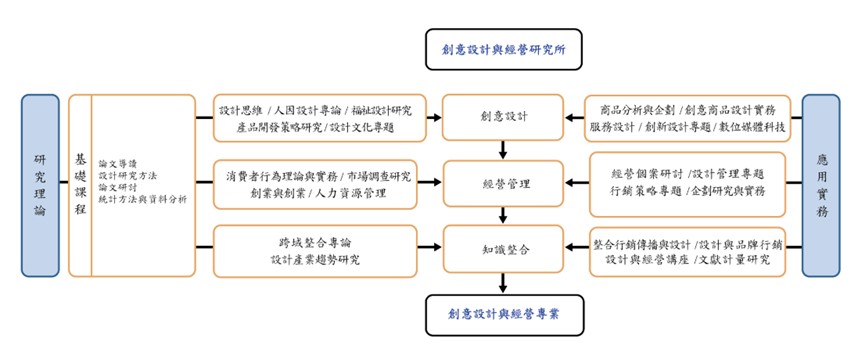
(1) Knowledge integration and design thinking; (2) Digital marketing and brand management; and (3) Creativity development and entrepreneurship management. Its educational objective is to nurture interdisciplinary professionals capable of integrating creative design and business management. To align with the development trends and talent demands of Taiwan’s design industry, this graduate institute has formulated its development focus - based on its positioning - around three key areas: Creative Design, Innovative Management, and Knowledge Integration. The future development framework is outlined in Figure 1.
In addition, the institute will fully leverage existing domestic educational resources, establish strategic alliances, and pursue resource sharing in curriculum and teaching activities. It will also seek support from academic societies and associations in areas such as curriculum development, industry experts and internship opportunities to realize the integration of ‘’theory’’ and ‘’practice’’.
(四) Strong Correlation with the University’s Characteristics and Development Positioning
Founded in 1917, NTUB is Taiwan’s first commercial school. Over the past century, the university has upheld a philosophy of high-quality, pragmatic, and application-oriented education. With over 120,000 alumni, many of whom are respected business professionals, NTUB graduates have long served across Taiwan’s business, financial and governmental sectors, earning widespread praise. Currently positioned as a teaching-oriented university for business management and innovation practices, NTUB’s mission is to provide the best business education by focusing on Business and Innovation as its two areas of specialization. Looking forward, it aims to evolve into a research-oriented university for business management and innovation applications, integrating academic research and practical teaching, with strategic goals focused on international collaboration and industry-government-academia-research partnerships. The aim is to cultivate talent who can integrate theory with practice, carrying on NTUB’s legacy of excellence and providing top-tier education in business and innovation.
The Institute of Creative Design and Management aligns with NTUB’s development vision by integrating technology, design and management, and focusing on creative design, innovation management and knowledge integration. Its mission to cultivate high-level interdisciplinary talent in creative design and management reflects NTUB’s educational strengths in business and innovation education, and supporting the university’s vision of becoming a research-oriented university for business management and innovation applications. It also aligns with NTUB’s educational strategy of developing theoretically and practically grounded entrepreneurial talent. As such, the institute’s positioning and development priorities are closely aligned with the overall development goals of the university.